Dear NC State
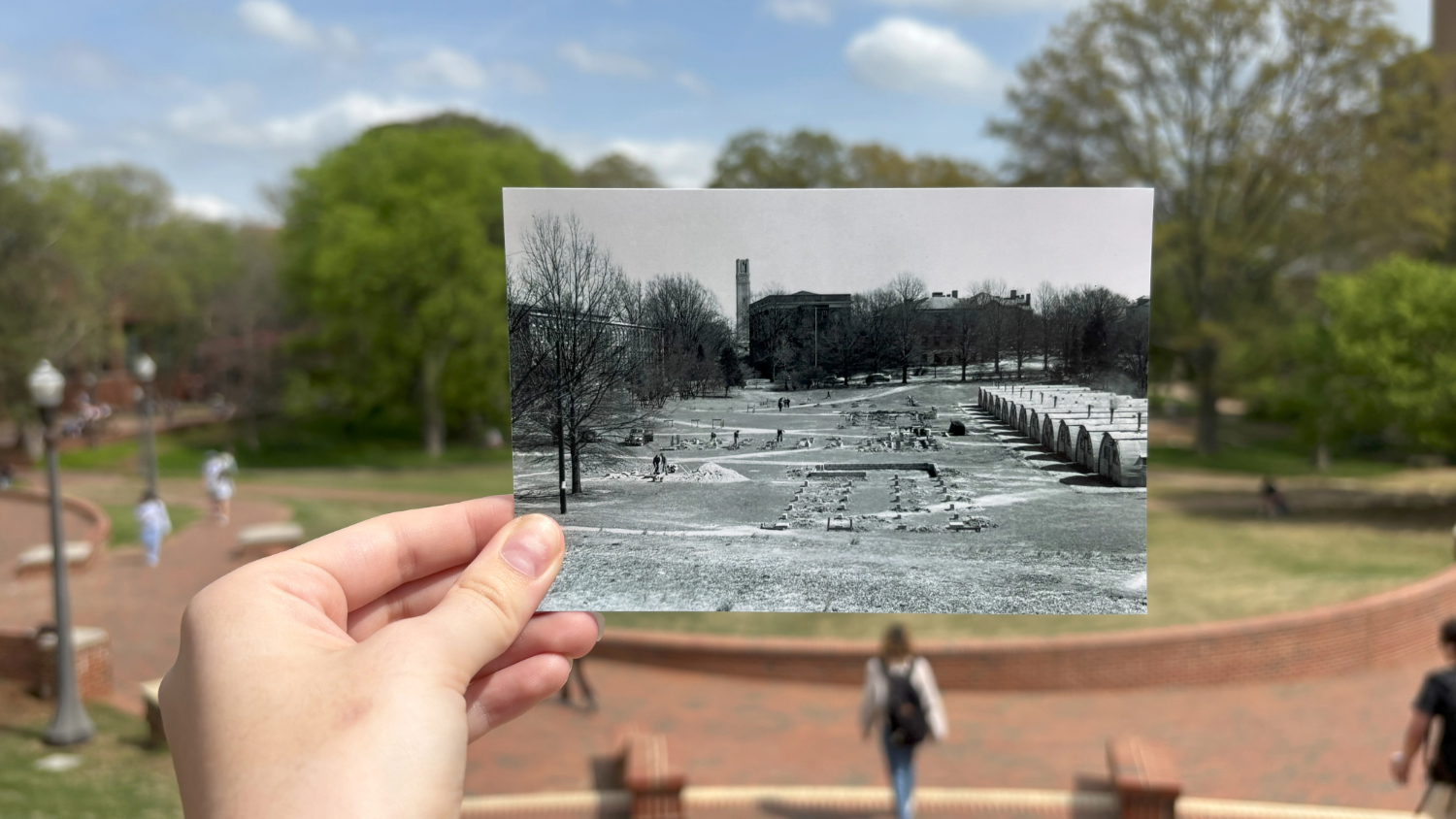
When I was in college, I came across a photography blog that left a lasting impression on me.
The blog, Dear Photograph, invited readers to get an old photo and take a picture of the photo in the same place it was taken, showing how things have changed or stayed the same over the years. It’s a way to connect the past with the present in one image.
Last year, when my team in University Human Resources and I discussed taking photographs of campus and featuring them in this newsletter, I thought about the Dear Photograph blog. It inspired me to do this project: Dear NC State.
At NC State, history is all around us. Buildings have changed, new spaces have been added, but the heart of campus remains the same. I was drawn to this project because I loved the idea of bringing history to life in a visual and meaningful way. I selected archival images of well-known campus sites from the NC State University Libraries’ Rare and Unique Digital Collections. A colleague had those photos printed at a local store. Our former intern, Kara Cushman, visited each campus location and framed the historic photos against the current landscape to create layered images that connect NC State’s past and present.
Each photo shows a piece of the university’s story and reminds us how far we have come while still holding on to who we are. I hope you enjoy the project as much as Kara and I enjoyed creating it.
The Belltower

The Belltower, whose cornerstone was dedicated on Nov. 11, 1949, stands as a tribute to alumni who lost their lives in World War I. Vance Sykes, a 1907 NC State graduate, proposed the idea for the memorial, and architect William Henry Deacy designed the tower. Today, the 115-foot-tall monument serves as a rallying point for our campus community.
Brooks Hall

The building now known as Brooks Hall and the home for the College of Design was NC State’s first library. In 1956, the building was assigned to the then-School of Design and was renamed for Eugene Clyde Brooks, a former university president.
The Court of North Carolina
The Court of North Carolina has served as a cow pasture and a site for classrooms and offices. It is now an open space where students gather. It was originally called the 1911 Field.
After World War II, the G.I. Bill of 1944 led to a big increase in enrollment at NC State, adding about 4,000 students. To handle the growth, the university built five two-story buildings and 12 Quonset huts. The huts held 40 to 45 students and were used as temporary classrooms.
Carter-Finley Stadium

Carter Stadium opened in 1966 and was named for alumni Harry and Nick Carter, who helped fund it. In 1979, Albert E. Finley’s last name was added to the stadium name in recognition of his support.
The Free Expression Tunnel

The Free Expression Tunnel is a popular place for students to create art and write messages.
- Categories:


